https://ritik398.blogspot.com/2023/03/the-abcs-of-heart-health.html
Category Archives: Health & Wellness
Exercise as Medicine
Check out this post… “Protecting Your Heart”.
Pollution increases heart disease.
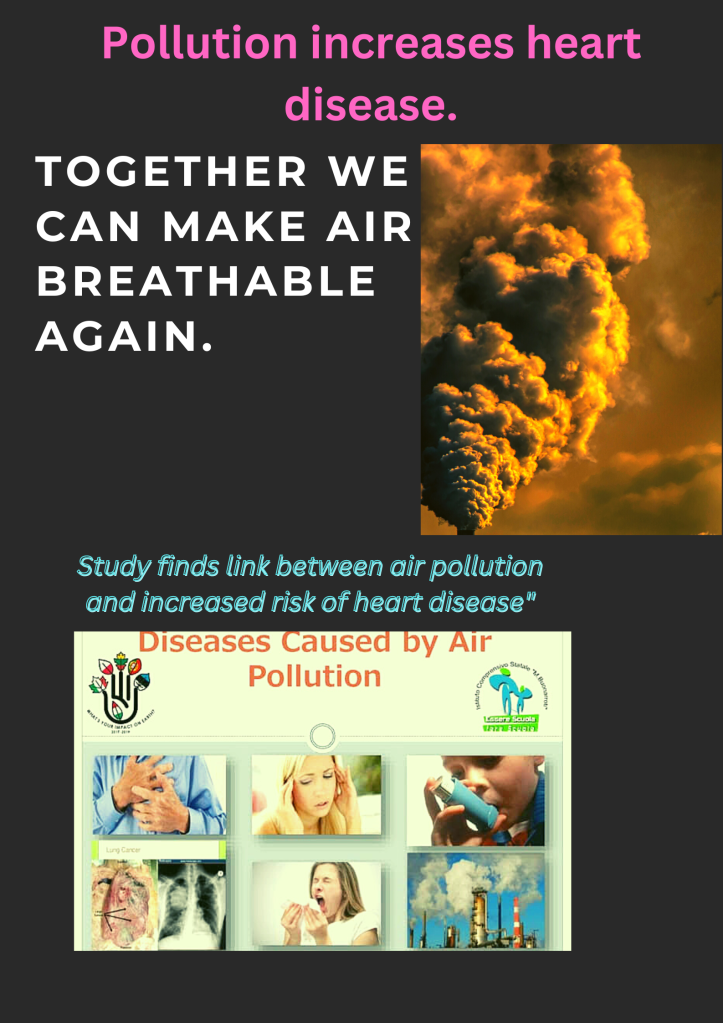
Study finds link between air pollution and increased risk of heart disease”
Air pollution has long been known to have negative effects on our respiratory health, but a new study has found that it may also be linked to an increased risk of heart disease.
The study, published in the journal Circulation, analyzed data from over 157,000 participants in the UK Biobank, a large-scale study that aims to improve the prevention, diagnosis, and treatment of a wide range of illnesses.
The researchers found that exposure to higher levels of fine particulate matter (PM2.5) and nitrogen dioxide (NO2) was associated with an increased risk of heart disease, even after accounting for other risk factors such as smoking, high blood pressure, and diabetes.
Specifically, for every increase of 5 micrograms per cubic meter of PM2.5, there was a 10% increase in the risk of heart disease. Similarly, for every increase of 10 micrograms per cubic meter of NO2, there was a 6% increase in the risk of heart disease.
The study’s lead author, Dr. Nay Aung from Queen Mary University of London, noted that the findings have important implications for public health policy.
“Our findings suggest that policies aimed at reducing air pollution levels to comply with WHO guideline levels might be expected to have long-term cardiovascular health benefits,” said Dr. Aung.
The World Health Organization recommends that the annual average concentration of PM2.5 should not exceed 10 micrograms per cubic meter and that the annual average concentration of NO2 should not exceed 40 micrograms per cubic meter.
However, many cities around the world still have air pollution levels that exceed these guidelines, highlighting the need for continued efforts to reduce air pollution and protect public health.
The study’s findings are particularly concerning given the widespread nature of air pollution. In 2019, the State of Global Air report estimated that air pollution was responsible for over 4.2 million premature deaths worldwide, making it the fifth leading risk factor for mortality.
While some countries have taken steps to address air pollution, including implementing regulations on vehicle emissions and transitioning to cleaner energy sources, progress has been slow in many parts of the world. In fact, air pollution levels have continued to worsen in some regions, such as South Asia and Sub-Saharan Africa.
In addition to its impact on heart health, air pollution has been linked to a range of other negative health outcomes, including respiratory illnesses, cognitive decline, and even certain types of cancer.
Children and elderly individuals are particularly vulnerable to the effects of air pollution, and exposure during pregnancy has also been linked to adverse birth outcomes such as low birth weight and preterm birth.
Given these serious health risks, it is important that policymakers take action to reduce air pollution levels and protect public health. This could include implementing stricter regulations on industrial emissions, promoting the use of public transportation and clean energy, and investing in green infrastructure such as parks and bike lanes.
Individuals can also take steps to reduce their exposure to air pollution, such as avoiding outdoor exercise during times of high pollution and using air filters in their homes.
Ultimately, addressing air pollution will require a coordinated effort from governments, industry leaders, and individuals around the world. However, the potential health benefits of reducing air pollution levels are significant, making it a crucial issue for public health and wellbeing.
Furthermore, the economic cost of air pollution is also significant. A report by the Lancet Commission on Pollution and Health estimated that the cost of air pollution-related illness and premature deaths was $5.1 trillion in 2019, equivalent to 7.1% of global GDP.
Reducing air pollution could, therefore, have significant economic benefits, as healthier populations are more productive and less burdened by healthcare costs. This could be especially important for low- and middle-income countries, where the burden of air pollution is often highest and economic growth is needed to improve the lives of citizens.
While reducing air pollution is a complex and multifaceted issue, it is clear that it should be a priority for policymakers and individuals alike. The findings of this study linking air pollution to an increased risk of heart disease add to the mounting evidence of the negative health impacts of air pollution, underscoring the need for action to protect public health and the environment.
In addition to government action, businesses and individuals can also play a role in reducing air pollution. For example, companies can adopt sustainable business practices and invest in clean energy, while individuals can choose to use public transportation or switch to electric vehicles.
There is also a need for further research to better understand the mechanisms behind the link between air pollution and heart disease. While the study suggests that the negative effects of air pollution on heart health may be related to inflammation and oxidative stress, more research is needed to confirm these findings and explore potential interventions.
In addition, it is important to note that the health effects of air pollution are not distributed equally across populations. Low-income communities and communities of color often bear a disproportionate burden of air pollution, as they are more likely to live in areas with high levels of pollution and may also have higher rates of pre-existing health conditions that make them more vulnerable to the negative effects of air pollution.
Efforts to reduce air pollution must therefore be accompanied by a commitment to environmental justice, ensuring that all communities have access to clean air and the resources necessary to protect their health and wellbeing.
In conclusion, the study linking air pollution to an increased risk of heart disease highlights the urgent need for action to reduce air pollution levels and protect public health. With coordinated efforts from governments, industry leaders, and individuals, it is possible to reduce air pollution and create a healthier, more sustainable future for all.
- WARNING: Exposure to pollution increases the risk of heart disease.
- CAUTION: Prolonged exposure to pollution can have a negative impact on heart health.
- NOTICE: Scientific studies have shown a link between pollution and an increased risk of heart disease.
- ALERT: Protect your heart by minimizing exposure to pollution.
- DANGER: Pollution is a major contributor to heart disease. Take steps to reduce your exposure today.
- IMPORTANT: Pollution can harm your heart. Consult with your doctor if you have concerns about your heart health.
- BEWARE: Prolonged exposure to pollution can lead to serious heart problems. Protect your heart by taking necessary precautions.
- ADVISORY: Individuals with pre-existing heart conditions are particularly vulnerable to the negative effects of pollution. Take extra precautions to protect your heart.
The Last Hope


In the aftermath of a devastating global pandemic, the world has been reduced to a barren wasteland. The remaining human population has been forced to retreat into underground shelters to survive. However, after several years of isolation, the air filters in the shelters begin to fail, and the survivors are forced to emerge back into the world.
Among them is a young woman named Maya, who possesses a unique genetic mutation that makes her immune to the virus that destroyed civilization. Maya is seen as the last hope for humanity, and is tasked with venturing out into the dangerous world to find a cure and rebuild society.
But as Maya travels through the ruined landscape, she discovers that she is not the only one with special abilities. There are others out there, people with extraordinary powers who have survived the pandemic. Maya must navigate this new world and decide who to trust as she races against time to find a cure and save humanity from extinction.
As she travels, Maya faces many challenges and obstacles, including dangerous creatures that have evolved in the new environment, rival factions vying for power and control, and her own inner demons as she grapples with the responsibility of being the last hope for humanity.
Will Maya succeed in her mission to save humanity, or will she succumb to the harsh realities of the post-apocalyptic world and become just another casualty of the pandemic?
As Maya ventures out into the world, she meets a diverse cast of characters, including a group of survivors who have formed a makeshift community in the ruins of a city. They are led by a charismatic but ruthless leader named Marcus, who sees Maya as a threat to his authority.
Maya also encounters a group of scientists who have been working on a cure for the virus. However, they are being held captive by a rival faction known as the Raiders, who seek to use the cure for their own gain.
As Maya works to unite these disparate groups and find a cure, she discovers that her own mutation may hold the key to saving humanity. But she must also confront her own fears and doubts, as well as the darker aspects of human nature that have been unleashed in the wake of the apocalypse.
As the story unfolds, Maya is forced to make difficult choices and sacrifices, and must confront the possibility that saving humanity may require her to give up everything she holds dear. Will she be able to rise to the challenge and become the hero the world needs, or will she fall victim to the same forces that brought about the end of civilization?
As Maya continues on her journey to find a cure, she learns more about the mutated creatures that now inhabit the post-apocalyptic world. These creatures, once ordinary animals, have been transformed by the virus into terrifying beasts with deadly abilities.
One such creature is a wolf named Koda, who Maya encounters while searching for food in the wilderness. Koda is different from the other mutated creatures Maya has encountered – he is friendly and intelligent, and seems to have a special connection with Maya.
Over time, Maya comes to see Koda as a loyal companion, and the two of them develop a deep bond. Maya learns that Koda is part of a pack of mutated wolves who have been driven to the brink of extinction by humans. Maya becomes determined to help Koda and his pack survive, and she sets out to find a way to reverse the effects of the virus and restore the wolves to their former state.
Meanwhile, Maya’s search for a cure leads her to a group of scientists who have been working on a cure for the virus. They explain that they have developed a serum that can reverse the effects of the virus, but they have been unable to produce enough of it to make a significant difference.
Maya learns that the Raiders, the faction holding the scientists captive, are in possession of a large supply of the serum. Maya hatches a plan to rescue the scientists and retrieve the serum, but the plan goes awry when the Raiders discover their escape attempt.
Maya is captured and brought before the Raiders’ leader, a ruthless man named Blake. Blake explains that he plans to use the serum to gain control over the remaining survivors and create a new society in his image. He offers Maya a choice – join him and rule at his side, or face certain death.
Maya refuses to give in to Blake’s demands, and is imprisoned alongside the scientists. However, Maya is not alone – Koda and his pack have followed her scent, and they launch a daring rescue mission to free Maya and the scientists.
The mission is successful, but not without cost – several of Koda’s pack are killed, and Maya is badly injured. However, they manage to retrieve the serum, and Maya returns to the underground shelters to administer the cure to the survivors.
Over time, the serum proves to be effective, and the survivors begin to recover from the effects of the virus. Maya becomes a hero among the survivors, and her bond with Koda and the other wolves endures.
Maya reflects on the lessons she has learned throughout her journey – that even in the face of impossible odds, there is always hope, and that the bonds of friendship and love can endure even in the darkest of times.
With the cure administered and the survivors on the road to recovery, Maya finally feels a sense of relief. However, she knows that the road to rebuilding society will be a long and difficult one.
Maya decides to take on a leadership role, using her unique perspective and experience to guide the survivors towards a brighter future. With the help of Koda and her other allies, Maya works to establish a new society that values cooperation, compassion, and innovation.
Over time, the survivors begin to thrive, building new homes, farms, and communities. Maya’s bond with Koda and the other wolves also endures, and she works to protect and preserve the environment and wildlife of the new world.
As the years pass, Maya watches as the scars of the pandemic slowly heal, and a new era of hope and prosperity begins. Maya realizes that while the world will never be the same as it was before, there is still the potential for a brighter future, and that she and her companions have played a vital role in bringing about that future.
In the end, Maya looks out over the horizon, thinking about the many adventures and trials that brought her to this point. She smiles, knowing that no matter what the future holds, she will face it with courage, determination, and the unwavering spirit of the last hope for humanity.
Dear 100-year-old Me,
Write a letter to your 100-year-old self.
I hope this letter finds you well, happy, and surrounded by loved ones. I can only imagine the incredible life journey you have had, filled with joys, struggles, triumphs, and lessons learned. As your 25-year-old self, I wanted to take this opportunity to reflect on our life so far and share some thoughts with you.
Firstly, I hope you have lived a life true to yourself, never compromising your values and beliefs for others. I hope you have pursued your passions and dreams and have experienced fulfillment and satisfaction in all aspects of life.
I also hope you have cherished the relationships that have come into your life, both old and new, and have cultivated meaningful connections with those around you. May your life be filled with love, laughter, and memories to last a lifetime.
As you reflect on your past, I urge you not to dwell on regrets or missed opportunities but to focus on the lessons learned and the growth that came from them. Embrace the present moment, knowing that it is a gift and an opportunity to make a difference in the world.
I cannot predict what the future holds for you, but I know that you have lived a life of purpose, resilience, and kindness. You have faced challenges head-on and have emerged stronger and wiser. You have made a positive impact on the world and have left a lasting legacy.
As I sign off this letter, I want you to know that your 25-year-old self is proud of who you are, what you stand for, and what you have accomplished. May the years ahead be filled
Goodbye
Describe the last difficult “goodbye” you said.
Saying goodbye can be difficult when it involves a significant change or separation, such as leaving a job or moving away from loved ones. The last difficult goodbye someone might have experienced could have been filled with a range of emotions, including sadness, nostalgia, fear, or anxiety. The person might have felt torn between wanting to stay and feeling the need to move on, or they might have struggled with the idea of leaving people or places they care about.
The goodbye itself might have been emotionally charged, with tears, hugs, and words that conveyed how much the person meant to them. There might have been a sense of finality or a fear of the unknown, as the person said goodbye and walked away from what they knew.
In some cases, a difficult goodbye might have been accompanied by a sense of relief, such as when leaving a toxic or abusive situation. Regardless of the circumstances, saying goodbye can be a challenging and emotional experience that requires strength, resilience, and a willingness to embrace change.
Top 10 Foods For Hairs Problems
Salmon: Salmon is rich in omega-3 fatty acids that help to nourish the scalp and hair follicles, promoting healthy hair growth.
Spinach: Spinach is packed with iron, vitamin A, vitamin C, and folate which are essential for healthy hair growth.
Eggs: Eggs are a rich source of protein, biotin, and vitamin B12 that help to nourish and strengthen the hair.
Avocado: Avocado is rich in healthy fats and vitamin E, which helps to nourish and moisturize the scalp and hair.
Greek yogurt: Greek yogurt is a great source of protein, vitamin B5, and vitamin D that help to promote healthy hair growth.
Sweet potatoes: Sweet potatoes are loaded with beta-carotene which is converted to vitamin A in the body, promoting healthy hair growth.
Nuts and seeds: Nuts and seeds are rich in vitamins, minerals, and healthy fats that help to promote healthy hair growth.
Blueberries: Blueberries are rich in vitamin C and antioxidants that help to protect hair follicles from damage and promote healthy hair growth.
Oysters: Oysters are a great source of zinc, which is essential for healthy hair growth and preventing hair loss.
Lentils: Lentils are a good source of protein, iron, and biotin that help to nourish and strengthen the hair.
Exercise as Medicine.
Exercise has become a dose of medicine
Exercise has indeed been shown to have many health benefits, and in that sense, it can be thought of as a kind of “medicine” for the body. Regular exercise has been linked to a range of positive outcomes, including,Exercise can be considered as a dose of medicine as it provides numerous physical and mental health benefits. Regular exercise can help prevent chronic diseases such as heart disease, stroke, diabetes, and cancer. It also helps to manage and reduce the symptoms of various mental health conditions such as depression, anxiety, and stress.
Improved cardiovascular health: Exercise can improve the health of your heart and blood vessels, reducing your risk of developing heart disease and stroke.
Better mental health: Exercise has been shown to reduce symptoms of depression and anxiety and boost mood.
Stronger muscles and bones: Exercise can help build and maintain strong muscles and bones, reducing the risk of falls and fractures.
Lowered risk of chronic diseases: Regular exercise has been linked to a lower risk of developing chronic diseases such as type 2 diabetes, some forms of cancer, and obesity.
Improved sleep: Exercise has been shown to improve sleep quality and duration, which can have a range of positive effects on physical and mental health.
Increased energy and productivity: Regular exercise can help increase your energy levels, making it easier to get through the day and be more productive.
Improved cognitive function: Exercise has been shown to improve cognitive function and memory, particularly in older adults.
Weight management: Exercise can help you maintain a healthy weight or lose weight if you need to. It can also help prevent weight gain in the future.
Increased flexibility and balance: Some forms of exercise, such as yoga and tai chi, can help improve flexibility and balance, reducing the risk of falls and injuries.
Social benefits: Exercise can be a great way to socialize and connect with others. Joining a fitness class or sports team can be a fun way to meet new people and make friends.
Reduced stress: Exercise can help reduce stress and improve overall mental health. It can be a great way to unwind after a long day or to take a break from work or other stressors.
Exercise is an essential part of a healthy lifestyle and can provide a range of physical and mental health benefits. It’s never too late to start incorporating exercise into your routine, and even small changes can make a big difference in your health and wellbeing.

incorporating exercise into your daily routine can have a wide range of health benefits and can help you feel your best both physically and mentally.
Reduced risk of injury: Exercise can help strengthen the muscles and bones, making them less prone to injury. It can also improve flexibility and balance, reducing the risk of falls and accidents.
Improved immune function: Regular exercise has been shown to improve immune function, reducing the risk of illness and infection.
Increased longevity: Exercise can help extend lifespan by reducing the risk of chronic diseases and improving overall health.
Reduced risk of cognitive decline: Exercise has been linked to a lower risk of cognitive decline and dementia in older adults.
Increased self-confidence: Regular exercise can help improve self-esteem and self-confidence, as well as reducing symptoms of anxiety and depression.
Better quality of life: Exercise can improve overall quality of life by boosting mood, reducing stress, improving sleep, and increasing energy levels.

Exercise has a wide range of benefits for physical and mental health, and it’s never too late to start incorporating it into your routine. Whether it’s a daily walk, a yoga class, or a game of basketball with friends, finding a form of exercise that you enjoy can have a significant positive impact on your health and wellbeing.
Improved heart and lung function: Regular exercise can improve heart and lung function, increasing endurance and reducing the risk of heart and lung diseases.
Reduced chronic pain: Exercise can help reduce chronic pain, particularly in conditions such as arthritis and fibromyalgia.
Improved digestion: Exercise can improve digestion and reduce the risk of constipation and other digestive problems.
Better skin health: Exercise can improve blood flow and oxygen delivery to the skin, promoting skin health and reducing the signs of aging.
Increased creativity: Exercise has been linked to increased creativity and productivity, making it a great way to boost creativity and problem-solving skills.
Reduced healthcare costs: Regular exercise can help reduce healthcare costs by reducing the risk of chronic diseases and lowering the likelihood of needing medical interventions.
Improved sex life: Regular exercise can improve sexual function and reduce the risk of sexual dysfunction in both men and women.

Exercise is a powerful tool for improving physical and mental health and can have a wide range of benefits for people of all ages and fitness levels. By incorporating exercise into your routine, you can enjoy better health, more energy, and an improved quality of life.
Increased bone density: Exercise can help increase bone density, reducing the risk of osteoporosis and fractures.
Improved insulin sensitivity: Regular exercise can improve insulin sensitivity, reducing the risk of type 2 diabetes and helping manage blood sugar levels.
Reduced inflammation: Exercise can help reduce inflammation in the body, which is linked to a range of chronic diseases and conditions.
Improved balance and coordination: Exercise can help improve balance and coordination, reducing the risk of falls and injuries.
Reduced risk of certain cancers: Regular exercise has been linked to a reduced risk of certain types of cancer, including breast, colon, and lung cancer.
Increased muscle strength: Exercise can help increase muscle strength and endurance, making it easier to perform daily activities and reducing the risk of injury.
Improved immune function: Regular exercise has been shown to improve immune function, reducing the risk of illness and infection.

Exercise is an essential part of a healthy lifestyle and can provide a range of physical and mental health benefits. Whether you prefer running, swimming, yoga, or strength training, finding a form of exercise that you enjoy and can stick to can have a significant positive impact on your health and wellbeing.
The recommended amount of exercise is at least 150 minutes of moderate-intensity aerobic exercise per week or 75 minutes of vigorous-intensity aerobic exercise per week, along with muscle-strengthening exercises at least two days per week.
In conclusion, exercise is a crucial component of a healthy lifestyle and can be considered as a dose of medicine to promote physical and mental health.
What is the biggest challenge you will face in the next six months?0
Learning new things is always a challenge for me. But with my sincere efforts, hard work makes them look easy and simpler. It is a better way to handle any challenge. The toughest challenges faced by me.
 Vitality Hub